Shape families
The polyhedra collections, their members and their sizes
Construct groups its shapes in families: smooth solids, polyhedra, lattices, engineering parts and fields. The Things finder shows them in that order under Primitives (see Find and add a definition). Most families hold one definition per shape. The polyhedra are different: a whole collection is one definition, and a parameter chooses the member.
| Definition | Members | The parameter that chooses |
|---|---|---|
| Prism | Right prisms with 3 to 64 sides | Sides |
| Antiprism | Right antiprisms with 3 to 64 sides | Sides |
| Pyramid | Right pyramids with 3 to 64 sides | Sides |
| Bipyramid | Right bipyramids with 3 to 64 sides | Sides |
| Platonic solid | The 5 Platonic solids | Solid |
| Archimedean solid | The 13 Archimedean solids | Solid |
| Catalan solid | The 13 Catalan solids | Solid |
| Kepler–Poinsot solid | The 4 regular star polyhedra | Solid |
| Johnson solid | The 92 Johnson solids | Solid |
A member costs the same as any other member of its definition, and a scene that uses several members compiles the definition once.
Size
Every member of a collection fits the same sphere: Diameter is the diameter of the sphere through the corners. A change of member keeps the size, so the shape does not jump in the viewport or in the preview.
The prisms and pyramids take a Diameter, the circle through the corners of the polygon, and a Height. They stand on the Y axis, centered on the origin. A change of Sides keeps both.
Prisms and pyramids
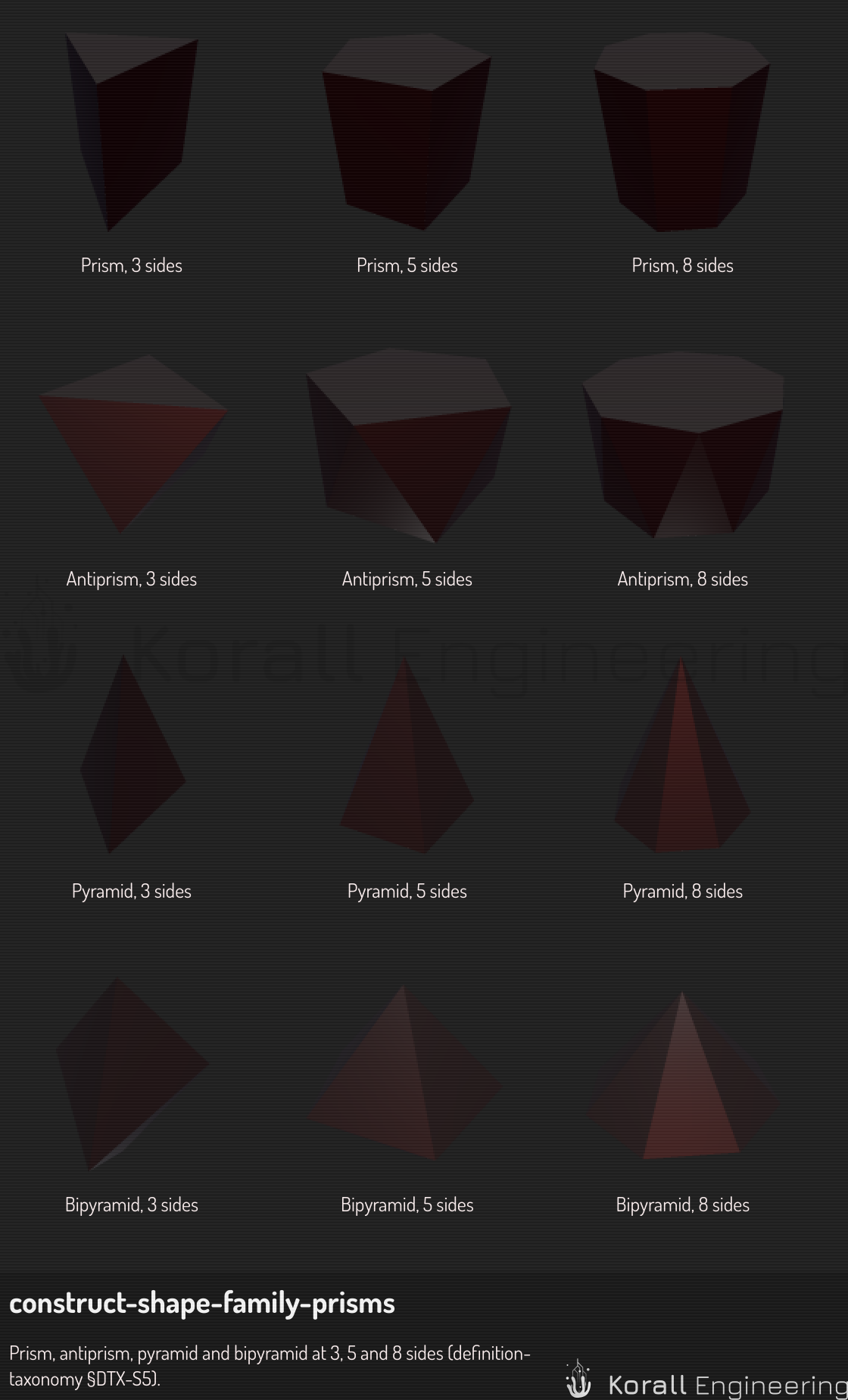
- Prism: two regular polygons joined by rectangles. Six sides make the hexagonal prism.
- Antiprism: two regular polygons, the top one turned by half a side, joined by a band of triangles. The default height makes the triangles equilateral for six sides. Three sides with a height of the diameter divided by √2 make the regular octahedron.
- Pyramid: a regular polygon base and an apex above its center. Four sides make the square pyramid.
- Bipyramid: two pyramids joined at their base. Four sides with a height equal to the diameter make the regular octahedron.
Platonic solids
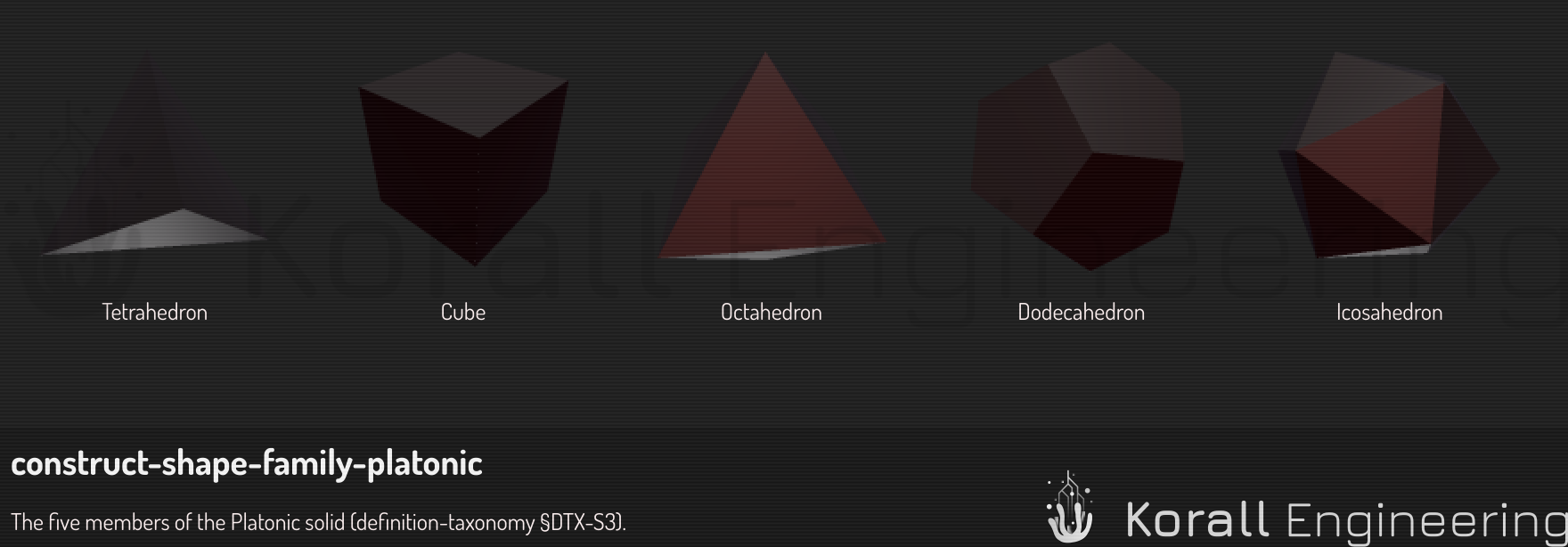
The tetrahedron, the cube, the octahedron, the dodecahedron and the icosahedron. Every face is the same regular polygon, and every corner is the same. The engineering form of the cube, with three sizes of its own, is Box.
Archimedean solids
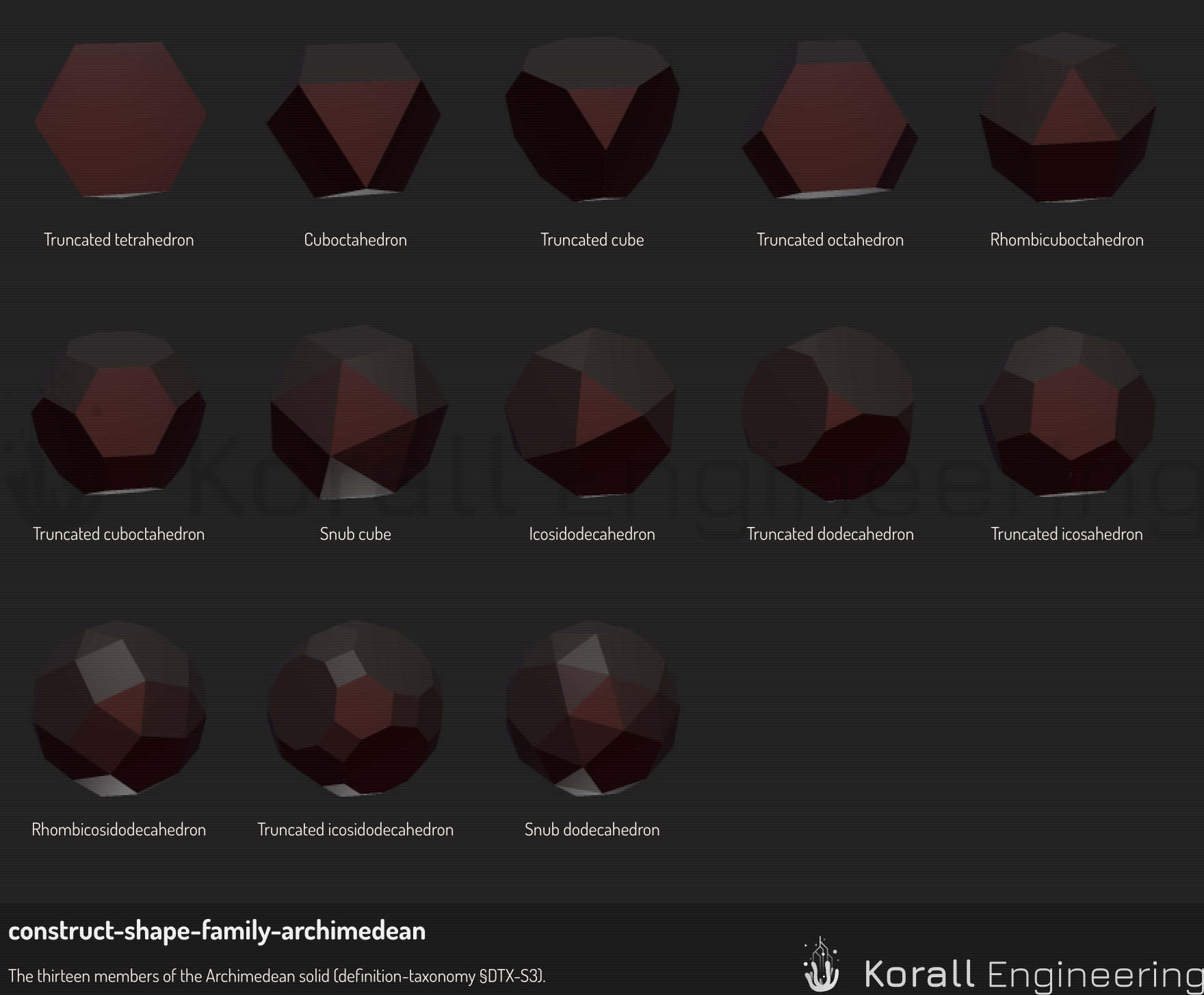
Every corner is the same, and the faces are regular polygons of two or three kinds. The snub cube and the snub dodecahedron are chiral: they have a left and a right hand, and Construct draws one of them.
The Archimedean solids are a mathematical collection: the finder folds them until you open them.
Catalan solids
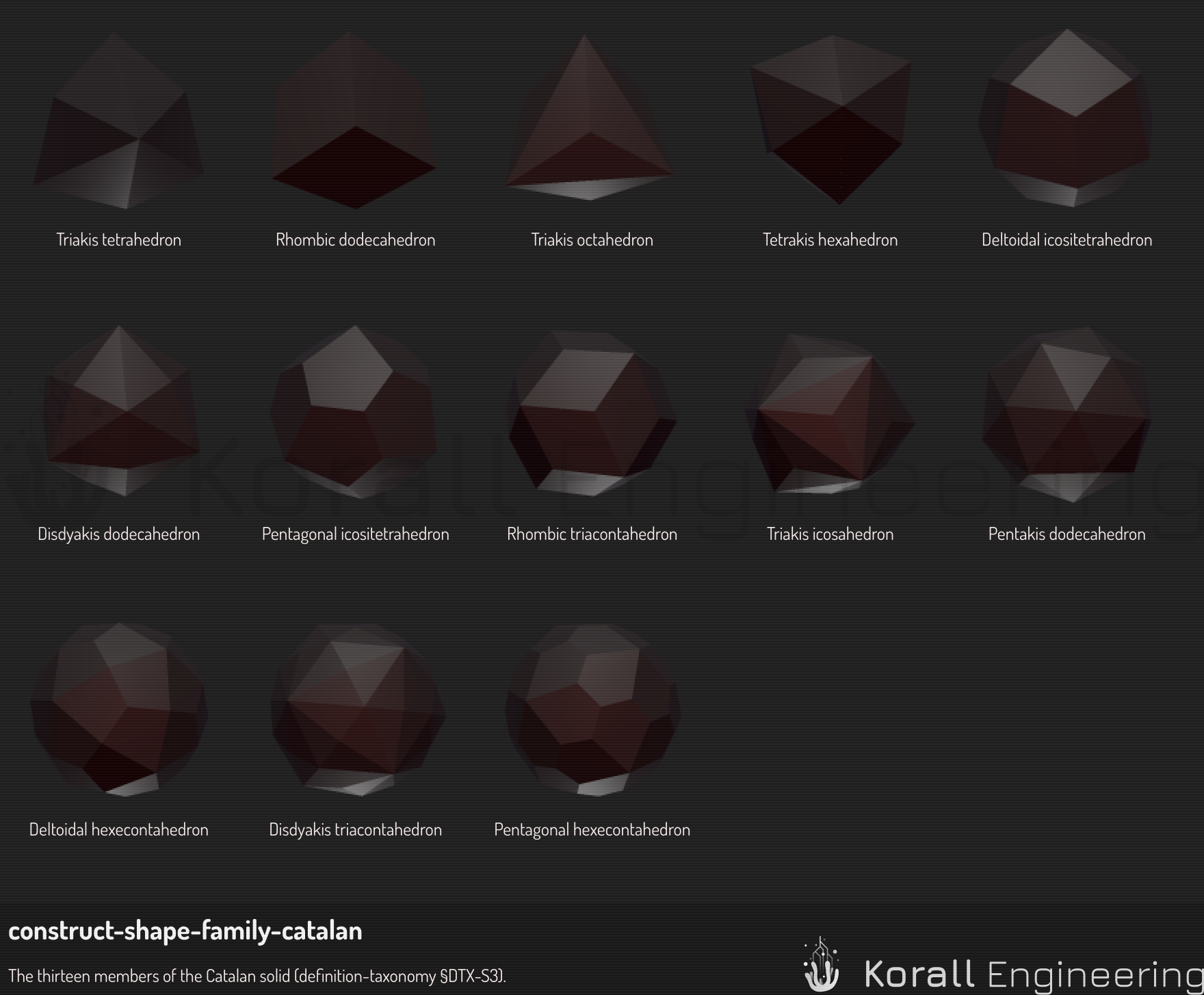
The duals of the Archimedean solids: every face is the same polygon, and the corners are of two or three kinds. The pentagonal icositetrahedron and the pentagonal hexecontahedron are chiral, as their duals are.
Kepler–Poinsot solids
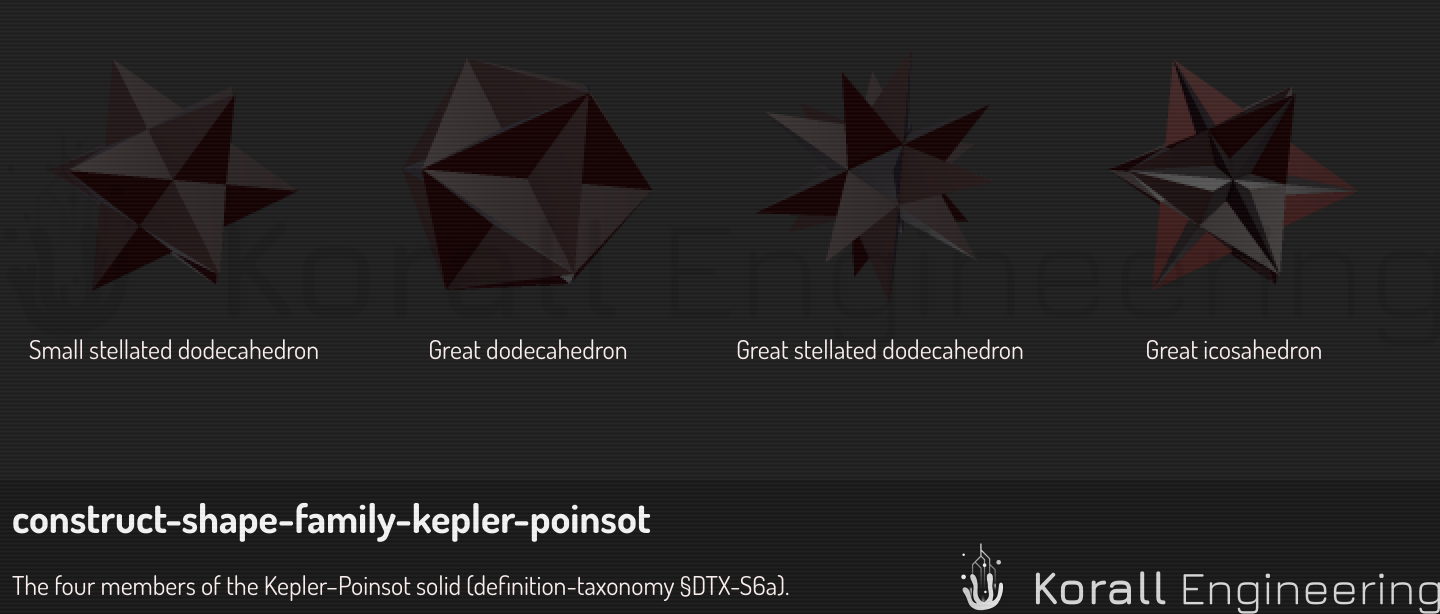
The four regular star polyhedra: the small stellated dodecahedron, the great dodecahedron, the great stellated dodecahedron and the great icosahedron. Their faces cross each other. Construct draws the solid that the faces enclose.
Johnson solids
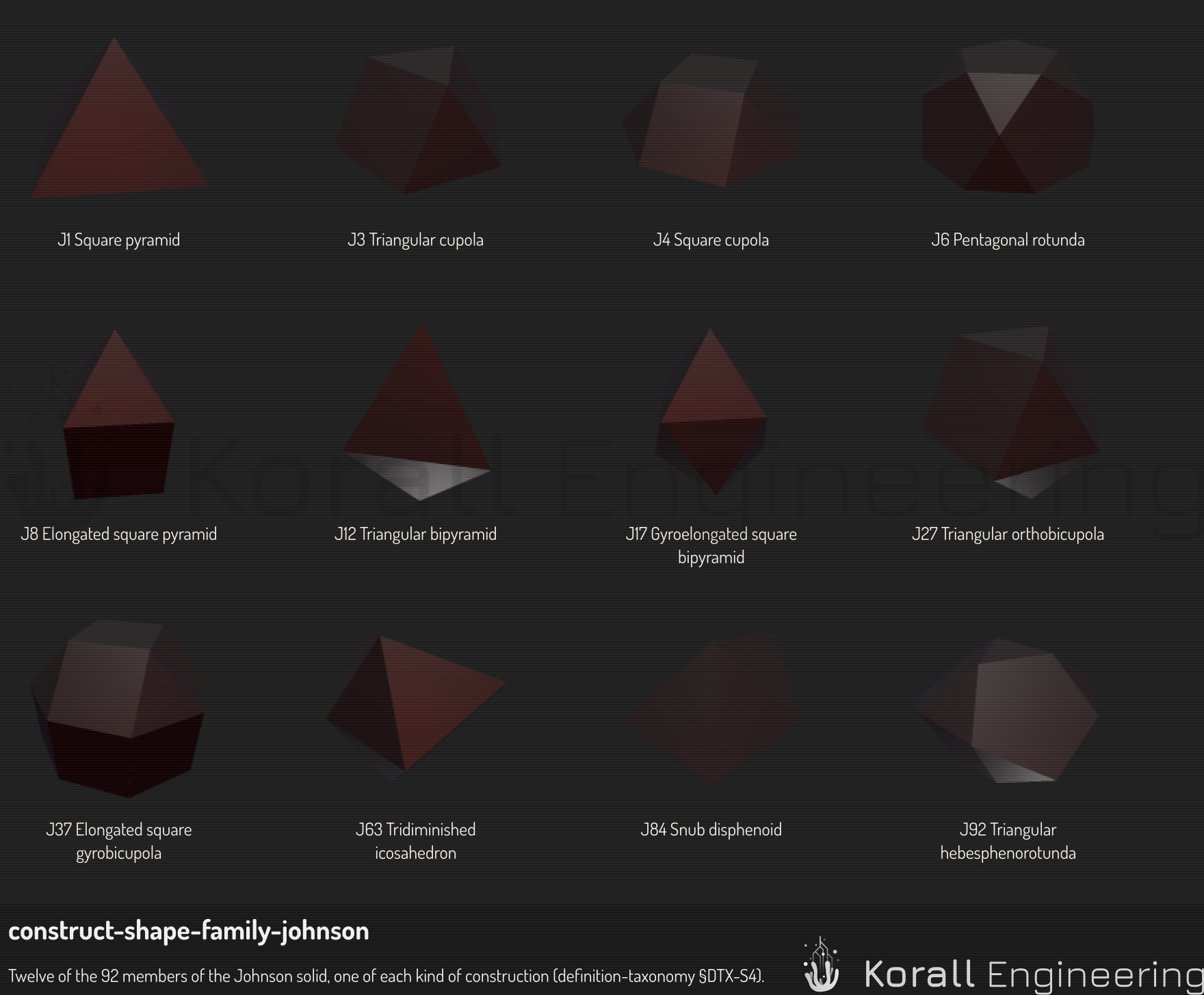
The 92 convex solids whose faces are all regular polygons and that are not Platonic, Archimedean, prisms or antiprisms. Solid chooses one of them by its number and name, from J1 Square pyramid to J92 Triangular hebesphenorotunda. Their face planes are a table of the definition, not code, so the 92 cost one definition.
Distance
The distance of every polyhedron is exact inside. The prism, the pyramid and the bipyramid are exact outside too. The others give a distance that is a little short near an edge or a corner outside the solid. The ray marcher takes a few more steps there, and the picture does not change. The star polyhedra give a shorter distance, about half the true one for the great icosahedron, so they draw more slowly than the convex ones.